Wiring 120v Outlet

Wiring 120v outlet
The high voltage (about 120 volts effective, 60 Hz AC) is supplied to the smaller prong of the standard polarized U.S. receptacle. It is commonly called the "hot wire". If an appliance is plugged into the receptacle, then electric current will flow through the appliance and then back to the wider prong, the neutral.
What wire do I use for 120 volt outlet?
To wire a 110 volt/120 volt outlet, you need 3 wires, green or bare copper is the ground, white is neutral, and usually black or red is the hot (live) wire (in this case my Hot is the purple wire). In the home, you will usually use Romex wire that you can get at the hardware store.
How do you wire a 110 volt outlet?
Pull the sheathing off and expose the bare wire. Make little hooks on the ends of the wires and wrap them around the electrical terminals. The black hot wire goes to the gold terminal, the white neutral wire goes to the silver terminal and the green or bare copper ground wire goes to the green colored terminal.
Which wire goes to which prong?
A polarized plug will have one prong wider than the other, which is the neutral, and usually silver-colored prong. The hot prong will be narrower and usually gold colored. With a non-polarized plug, you can wire either wire to either prong.
Is the wide prong hot or neutral?
The wide prong on the plug links the threaded base of light bulbs to the neutral terminal (the wider slot) in the receptacle. The hot side of the outlet (the side that can deliver a shock) is wired to the threaded socket if the wires are reversed.
Is the smooth or ribbed wire hot?
The ribbed side of the line cord indicates the neutral wire, the smooth side, the hot wire. If we are wiring a line cord plug, the ribbed wire would connect to the wider space or neutral space on the plug itself.
Should I use 12 or 14 gauge wire?
Only use 14-gauge wire for an outlet if the outlet is on a 15-amp circuit. If the outlet is on a 20-amp circuit, it should be wired with 12-gauge wire. You can also use 12-gauge wire for outlets on 15-amp circuits.
Is it OK to use 12 gauge wire on a 15 amp circuit?
However, 12-gauge wire is acceptable on both 15- and 20-amp circuits, so some electricians use it exclusively when wiring a house. This avoids the potential for mixing wire gauges in future repairs or additions, which is prohibited by the National Electric Code because it's a fire hazard.
Is 110 volt and 120 volt the same?
Sometimes you may hear 110 volt plugs referred to as 120 volt. Do not be confused by this; think of them as one and the same. There are a few variations of the 110 volt outlet based on the size of the breaker associated with the circuit, which is measured in Amps. The 2 most common variations are 15 Amp and 20 Amp.
Which side of 110 outlet is hot?
Looking at the receptacle itself, the hot side is the side of the outlet the thinner prong plugs into. The thin prong is the hot wire, and the thick prong is the neutral wire.
Does it matter which side of outlet is black wire?
White (neutral) goes on the side allocated for the larger prong. Black (Hot) goes on the smaller prong side or white to silver screws, black to gold screws. Ground (bare wire) to green.
Are 115 volt and 120 volt the same?
You'll often hear voltages in your home referred to as 110V, 115V, or 120V. This can be confusing but the bottom line is they are referring to the exact same thing. 120V is the AC voltage on a single hot wire in your home with respect to neutral (or ground).
What color wires go on an outlet?
The black wire is the "hot" wire, it carries the electricity from the breaker panel into the switch or light source. The white wire is the "neutral" wire, it takes any unused electricity and current and sends it back to the breaker panel.
When wiring a plug what Colours go where?
Wiring a 3 Prong Plug The power cord has a white wire, green wire, and a black wire. The white wire is connected to the silver or light colored screw, the green wire is connected to the green screw and the black wire is connected to the gold or dark colored screw.
What is the correct way to install an electrical outlet?
The National Electrical Code (NEC) doesn't require a certain direction. The NEC allows outlets to be installed with the ground plug hole facing up, down or sideways. It's up to you, there is no standard electric outlet orientation. So that means there really is no such thing as upside down outlets.
How do I know which wire is hot and neutral?
The hot wire is always smooth on the outside of the cord, while the neutral wire is ribbed on the outside. For flat cords with polarized plugs on the end, the larger prong (or terminal) is the neutral wire.
Which side is live on a plug?
The live wire is on the left-hand side while the neutral wire is on the right-hand side. It is fairly simple to connect the wires to the plug socket this is because all plugs today come with connectors. Wiring a plug socket is extremely simple and can be easily done by beginners.
Does the neutral wire carry current?
The neutral carries current if the loads on each phase are not identical. In some jurisdictions, the neutral is allowed to be reduced in size if no unbalanced current flow is expected. If the neutral is smaller than the phase conductors, it can be overloaded if a large unbalanced load occurs.
Is the wide prong black or white?
The wide prong is attached to what some people call the neutral but really is called the identified conductor. It is identified by: Being white in color; or. Having ridges running along its length that you can feel with your fingers.
How can you tell which side of wire is positive?
If you have a wire where both sides are the same color, which is typically copper, the strand that has a grooved texture is the negative wire. Run your fingers along the wire to determine which side has the ribbing. The smooth wire is the positive wire.
13 Wiring 120v outlet Images
Understanding 240V AC Power for HeavyDuty Power Tools Basic

Pin by Nate Jones on Truck camper Outlet wiring Trailer wiring

Electrical Outlet Types 14 Different Types of Electrical Outlets

Pin by Asif on Asi electrical wiring Electrical wiring Electricity Wire

Have a Ryobi Battery That Wont Charge You Can Fix That Ryobi

practical electrical wiring residential farm commercial and industrial

Control System Basic Wiring Practice Animation Diagram Humanmachine

Size 10 to 14 Inch Color Gold Bulb Base E12E14 Bulb Included No

HT106B Socket Outlet Tester Circuit Polarity Voltage Detector Wall Plug
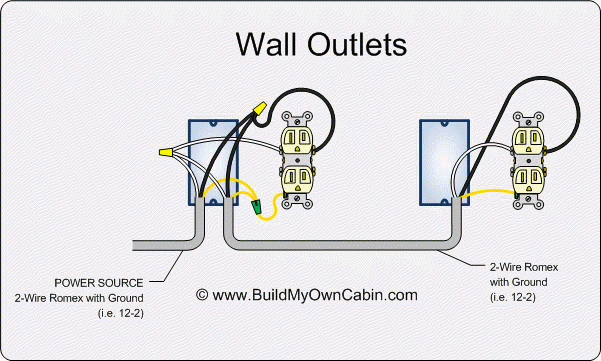
Electrical wiring diagram Electrical wiring and Dining rooms on Pinterest

House Wiring Smart Home Tot Quick Thursday Engineering Hobbies

the wiring diagram for an electric motor with two motors and one wire

Post a Comment for "Wiring 120v Outlet"